Taobao vs. Alibaba vs. Aliexpress vs. Temu: Keys Differences and Which is Right for You?
Taobao vs. Alibaba vs. Aliexpress vs. Temu: Overview
【Cashback from Extrabux】Up to 40% cashback
Founded by famous Chinese entrepreneur Jack Ma and Alibaba Group in 2003, Taobao is the largest e-commerce marketplace in China. It is almost synonymous with shopping online for affordable Chinese products. Taobao dominates the industry with more than 170 million users. The biggest appeal with it is the large volume of sellers. With over 800 million product listings, shoppers are able to purchase a wide range of items from this platform including home decor, fashion and apparel, electronics and gadgets, beauty and personal care, children's products, storage boxes and even furniture!
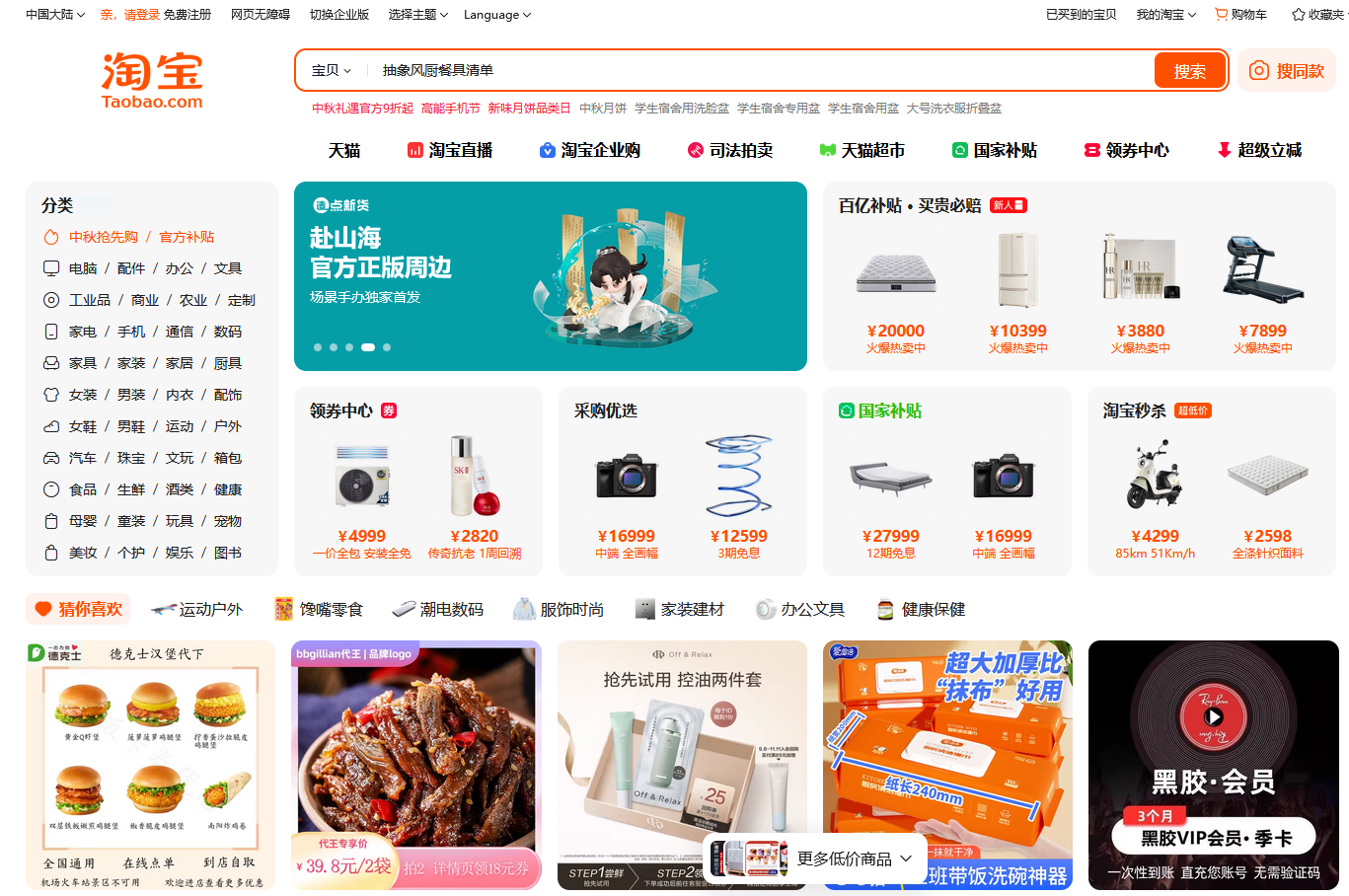
Consumers can always look forward to November 11th, known as “singles day” or locally as “shuang shiyi”, where you can purchase heavily discounted merchandise as part of the world’s largest shopping extravaganza. Taobao provides a global site for overseas Chinese and foreigners, offering a variety of international shipping services to deliver goods to your overseas shipping address. Currently, Taobao supports consolidation or direct shipping to the following countries or regions: Hong Kong, China, Macau, China, Taiwan, Malaysia, Singapore, USA, Canada, Australia, New Zealand, Japan. However, it can be challenging for foreign buyers to buy here due to language barriers.
| PROS | CONS |
The absolute largest selection of products, including unique Chinese items. | The interface and sellers are almost exclusively in Mandarin Chinese |
| Extremely low prices | Geoblocked for most international buyers. You need a proxy/agent (e.g., Superbuy, CSSBuy) to ship abroad |
Direct access to Chinese trends and products | No English customer service |
| Payment outside China is difficult (often requires an agent) |
【Cashback from Extrabux】Up to 10% cashback
Founded in 1999 by Jack Ma, Alibaba is the leading China sourcing website these days that connect businesses with millions of Chinese suppliers across diverse product categories.. While its sister site AliExpress is for retail, Alibaba is designed for B2B (Business-to-Business) transactions. It offers a wide range of products across various categories, including electronics, fashion, home goods, and more. Buyers for these products are located in 190+ countries and regions and exchange hundreds of thousands of messages with suppliers on the platform each day.
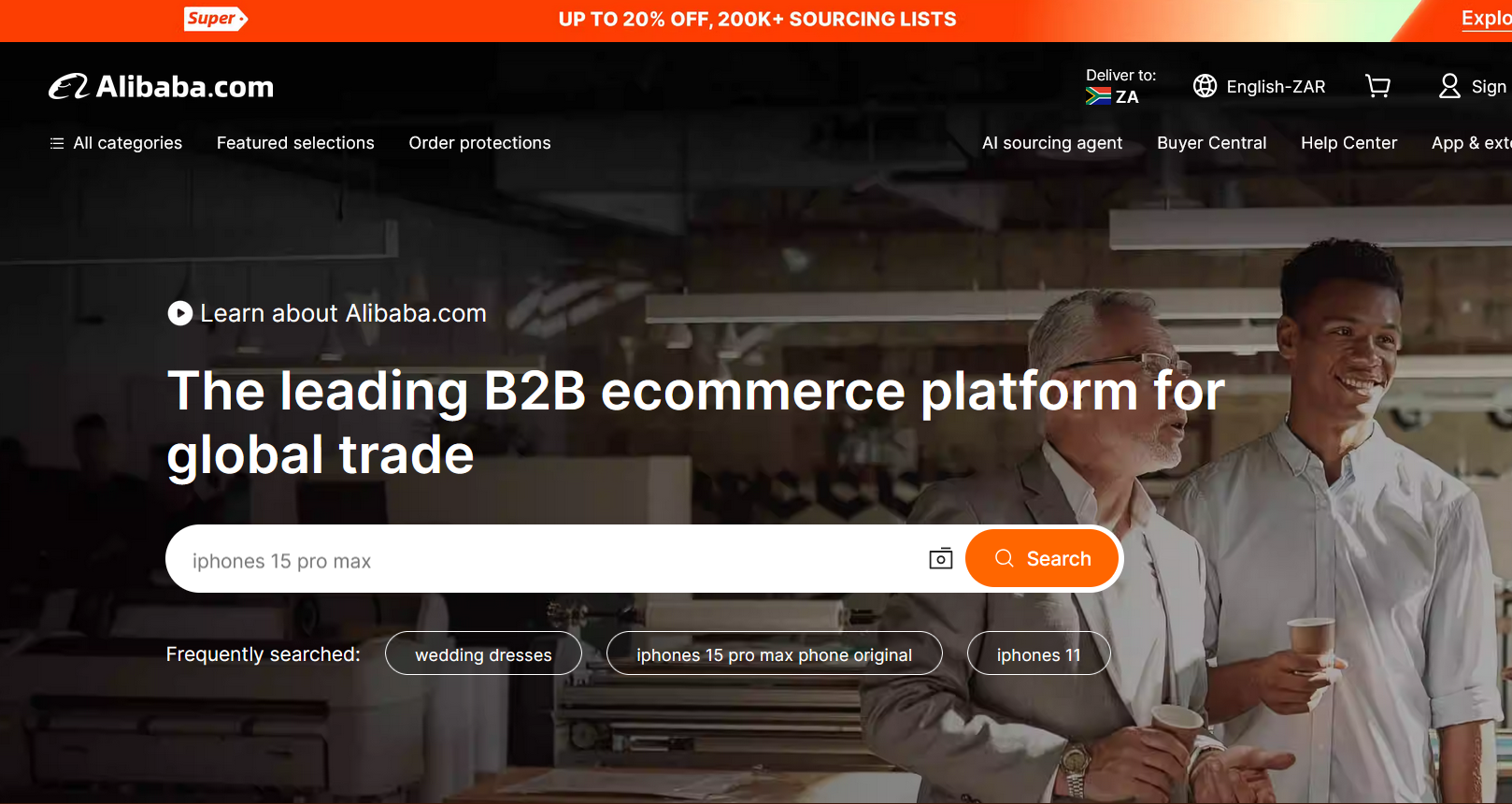
Alibaba has been around for almost 2 decades and has never disappointed its users. Goods are cheaper on Alibaba because they’re sold mostly by the manufactures or their direct agents. The platform also offers a range of tools and services, such as trade assurance, secure payment, and logistics support, to facilitate smooth transactions between buyers and suppliers. Before finalizing any deal, buyers can ensure the credibility of the suppliers by checking company profile metrics and availing of the quality inspection service.
| PROS | CONS |
Lowest possible per-unit prices on earth (if you meet the Minimum Order Quantity) | Very High Minimum Order Quantity (MOQ) - Not for individual consumers |
Incredibly vast range of products and manufacturers | Risk of scams is higher; you must vet suppliers carefully |
| Suitable for customizing products (OEM/ODM) and private labeling | Shipping is complex and expensive (you often arrange it yourself) |
Trade Assurance program offers good payment protection for orders |
Saving Tip: Such a high amount of cash back comes from Extrabux (What is Extrabux?), it also offers coupon codes and recent promotions, and brings together 10,000+ sites (US, China, UK, Japan, Australia , Germany, France, Italy, etc.).
Just sign up for an Extrabux account and earn up to 80% cash back every time you place an order via the relevant link. Sign-Up Bonus: Join for FREE & Earn $20 Welcome Bonus today! Then earn $5 Friend Referral Bonus!
【Cashback from Extrabux】Up to 10.5% cashback
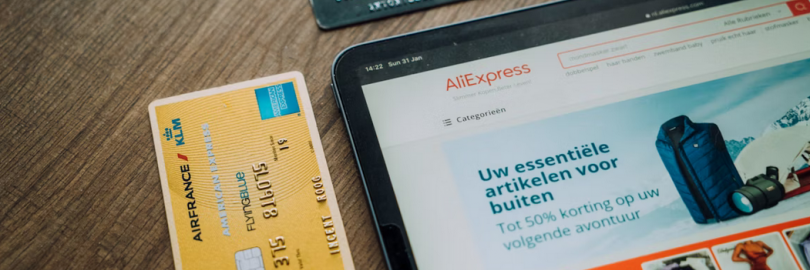
Launched in 2010, Aliexpress is an online retailer based in China which is owned by the Chinese company Alibaba. It started as a business-to-business portal then later ventured into business-to-consumer (B2C) services and consumer-to-consumer services, and even cloud computing and payment services. Even though AliExpress is head quartered in Hangzhou, China, it has a prominent market share in other countries too like Singapore, Russia, Brazil, and the United States. Now, AliExpress has become a leading B2C e-commerce platform, and sellers are typically small to medium businesses. It is similar to eBay, where sellers are independent and can set up their own shops. AliExpress doesn't sell its own products.
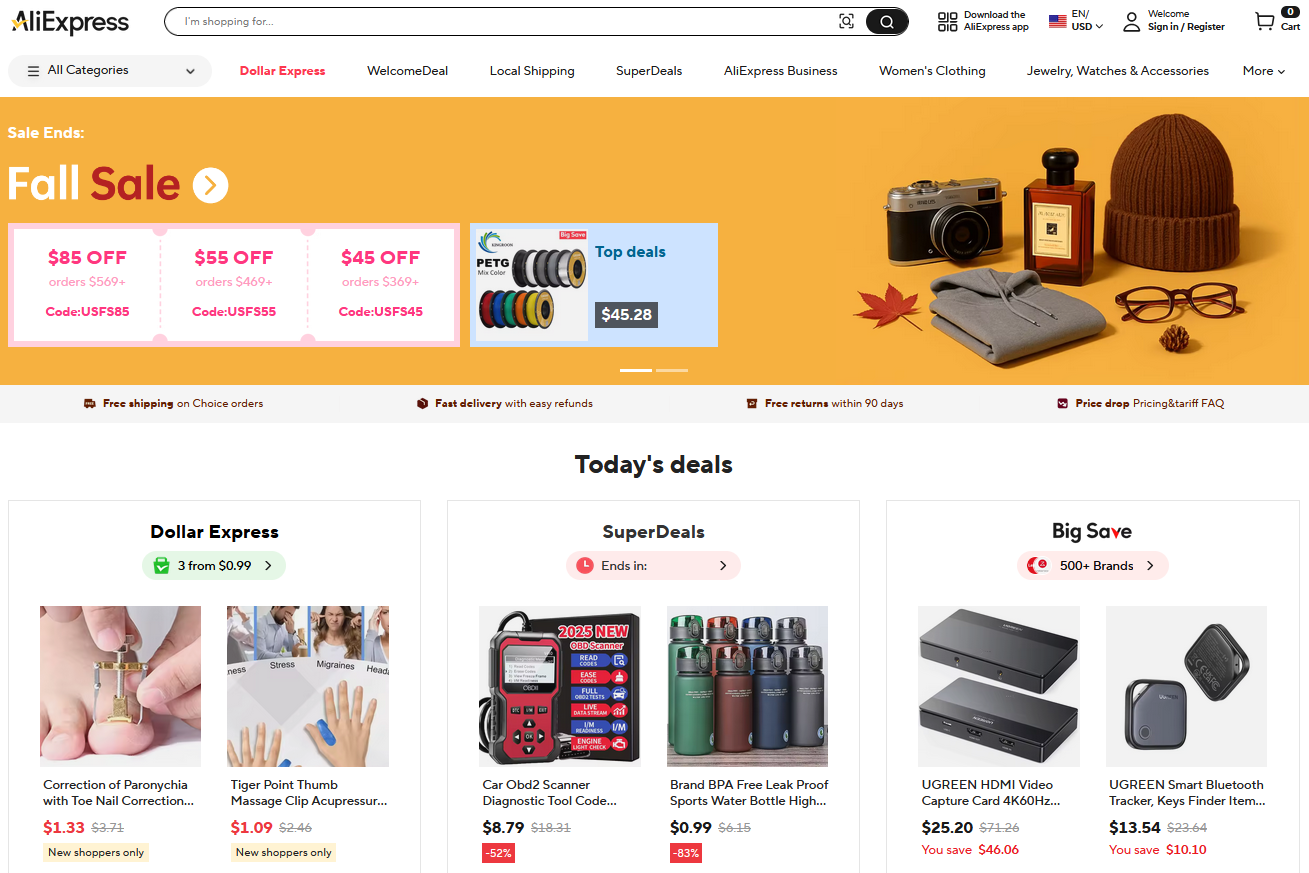
Aliexpress is inarguably one of the most popular online marketplaces for a variety of items. From household electronics to tech gadgets, beauty supplies, men’s and women’s clothing, there’s no end to the type of stuff you can get on the website. To put it briefly, the category of goods on AliExpress covers almost all day-to-day items that most people require. Buyers can order as low as 1 item and enjoy fast delivery and full tracking services. This comprehensive platform also offers discounts on bulk purchases in every product category. It stands out for its competitive prices. You can find products from well-known brands as well as cheaper items from independent suppliers.
| PROS | CONS |
Over 100 million products in diverse categories | Prices are higher per unit than Alibaba or Taobao |
| Very low prices for single items (no MOQ) | Shipping can be very slow (15-45 days is common for free shipping) |
Fully translated into many languages and easy to use | Product quality can be hit or miss (check seller ratings!) |
| Mature buyer protection (dispute resolution, refunds) | |
Global shipping to 200+ countries and free shipping on many products |
【Cashback from Extrabux】Up to 35% cashback!
Temu is owned and operated by the Chinese-based and Cayman Islands registered company PDD Holdings, which also owns Pinduoduo, a well-known online commerce platform in China. It was launched in the United States in September 2022 and attained massive growth in the first few months of its release. A year later, they expanded their reach to Australia and New Zealand. Today, they have coverage in many other countries, including the UK, Germany, Spain, and top markets in Asia. As of now, Temu enjoys traffic of 100 million active users, and that is for the United States alone. Globally, there are over 130 million app downloads for the platform. Overall, Temu enjoys 420 million monthly visits to its platform.
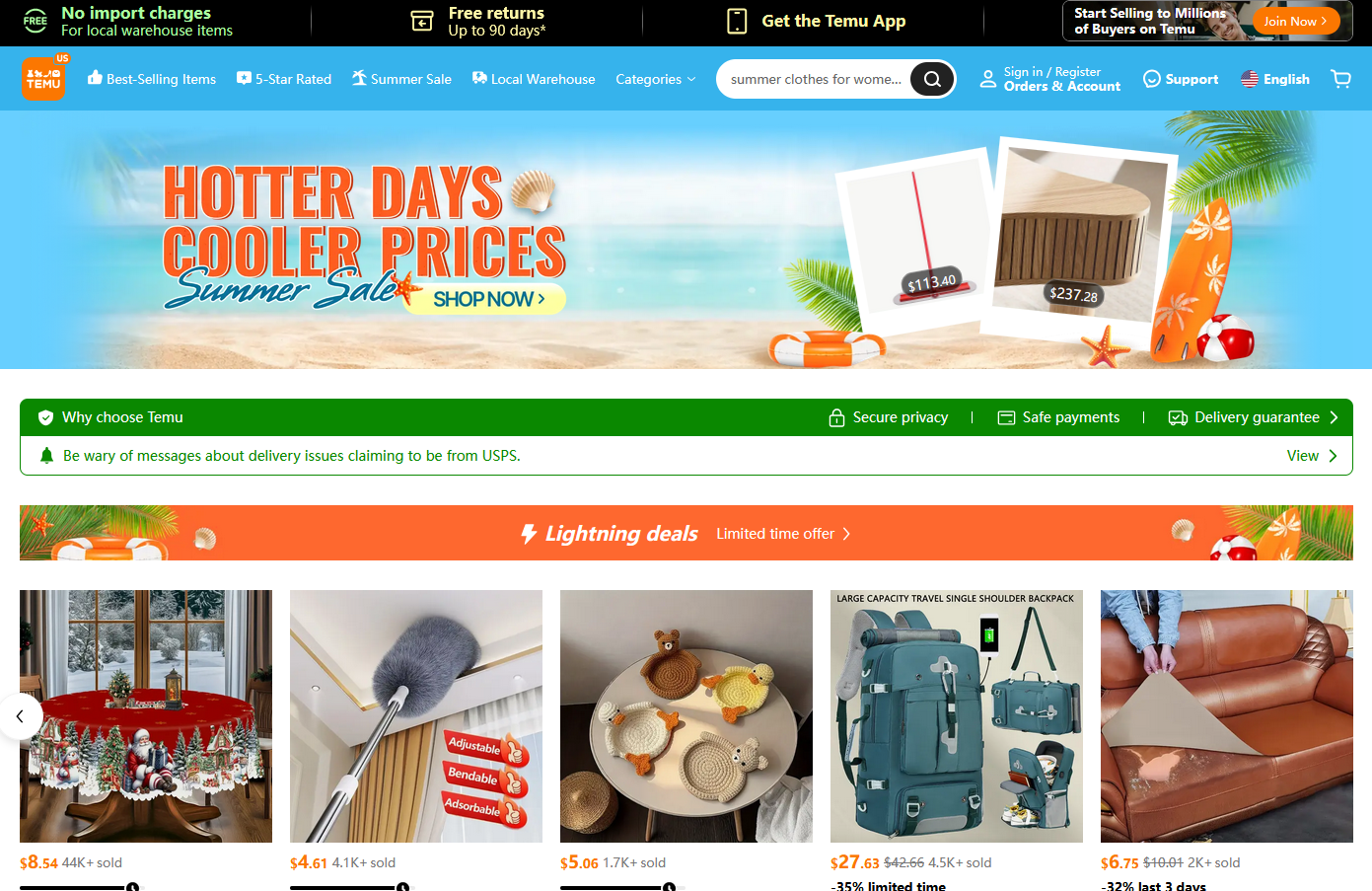
Temu has an extensive range of daily life products, such as trendy clothing, footwear, accessories, beauty products, and more. As a newcomer to the scene, Temu is a rising star in the budget-friendly online shopping world. It is somewhat similar to Groupon but with a new way of shopping and social media marketing. It allows China-based vendors to sell and ship directly to customers without relying on warehouses in the destination country. One factor that makes Temu stand out is its affordable prices, making it accessible to all types of audiences. The platform is famous for marketing strategies that emphasize discounts and freebies, and it sells products at lower prices than Amazon.
| PROS | CONS |
The absolute lowest prices for single items on the global market | Extremely inconsistent quality; it's the ultimate "you get what you pay for" platform |
Always free shipping and frequent promotions | Shipping, while free, can be slow and less predictable |
Very user-friendly and addictive app with games and deals | |
90-day return window (the longest of the four) |
Taobao vs. Alibaba vs. Aliexpress vs. Temu: Keys Differences
Before diving into my in-depth discussion, look at the table below to get a key differences of them.
| Feature | Taobao | Alibaba | AliExpress | Temu |
| Business Model | C2C/B2C (Consumer-to-Consumer/Business-to-Consumer) | B2B (Business-to-Business) | Primarily B2C, supports "Small Quantity B2B" (bulk discounts) | B2C (Business-to-Consumer) |
| Target Audience | Chinese Consumers | Wholesalers, Importers, Businesses | International Consumers, Small Retailers | International Consumers (Price-Sensitive) |
| Price Point | Low | Extremely Low (but high MOQ) | Low to Medium | Extremely Low |
| MOQ (Min Order Qty) | Low (often 1 piece) | Very High (e.g., 100+ units) | Low (1 piece) | Low (1 piece) |
| Product Variety | Largest Variety (everything imaginable) | Wide (focus on bulk, raw materials, OEM) | Extremely Wide (massive marketplace) | Good (curated selection) |
| Product Quality | Varies wildly (needs Chinese savvy) | Varies wildly (due diligence required) | Generally decent for price | Inconsistent (You get what you pay for) |
| Shipping | China-domestic only ( international need agent) | Negotiable (Sea freight, Air, DDP/DAP) | International (often free/cheap, slow) | Free Shipping (Slow, 7-15 days common) |
| Language/UI | Chinese only | English & Chinese | Fully localized (many languages) | Fully localized |
| Buyer Protection | Standard (but language barrier is a major hurdle) | Low (relies on contracts and supplier relationships) | Strong (dispute system, money-back guarantee) | Excellent (heavy bias towards buyer to build trust) |
1. Business Model
Taobao is a massive C2C and B2C marketplace mainly for consumers within mainland China. Think of it as the Chinese Amazon or eBay, with millions of individual sellers and small businesses.
Alibaba is the original B2B wholesale platform. It connects manufacturers and trading companies (mainly from China) with businesses around the world looking to buy in bulk.
AliExpress is the B2C little brother of Alibaba, designed for international consumers to buy small quantities at low prices. It's a gateway for global retail. AliExpress also supports "Small Quantity B2B" (bulk discounts).
Temu is a hyper-aggressive B2C platform using a "first-order wholesale" model. It acts as the retailer, sourcing products directly from manufacturers (often the same ones on Alibaba) and selling them at rock-bottom prices to consumers outside China.
2. Prices
Taobao offers the best prices for consumers within China due to fierce competition between sellers. For international buyers, agent fees and shipping costs can negate this advantage.
Alibaba is not for retail. The listed "price" is usually a starting point for negotiation (MOQ - Minimum Order Quantity). The per-unit price becomes very low when ordering hundreds or thousands of items.
AliExpress offers generally low prices for single items or small bundles. Prices are higher than Temu on average but can be more consistent. Frequent sales (e.g., Choice Day, Anniversary Sale) offer good discounts.
Temu is the undisputed king of low retail prices. Temu uses an aggressive strategy, subsidizing costs and leveraging its supply chain to offer rock-bottom prices. They often run games and promotions that further drop prices.
3. Products Variety & Quality
Taobao offers the largest variety of any platform, including unique, custom, and niche products directly from Chinese designers and manufacturers. The product quality is a complete mixed bag. There are genuine brands and high-quality items alongside counterfeits and ultra-cheap junk which requires careful research (using translation tools).
Alibaba is focuses on bulk, wholesale, and business-to-business transactions. You can find raw materials, pre-built products, and manufacturers offering OEM/ODM (Original Equipment/Design Manufacturing) services. Quality is tied to the specific supplier. You must verify the supplier by checking company certifications, reviews, and ideally ordering samples before committing to a large production run.
AliExpress is a vast marketplace of individual sellers features overall variety (literally almost anything, including electronics, fashion, beauty, home, toys, auto, tools, craft supplies etc. ). The products quality is better than Temu on average but still requires you to read reviews and check seller ratings diligently.
Temu has massive variety (including home goods, electronics/accessories, apparel, kitchenware, toys, beauty, tools, etc.). You'll find popular, trendy items but not the deep, niche selection of AliExpress or Taobao. Quality is a major gamble. It's often the lowest tier of quality. Best for non-critical, disposable, or novelty items. Do not expect durability.
4. Shipping Options, Speed & Costs
Taobao is designed for the domestic Chinese market. Its entire ecosystem, including logistics, is optimized for speed and cost within China. It offers lightning-fast free shipping within China (2-3 days). For international buyers, you must use a third-party shipping agent (e.g., Superbuy, CSSBuy, Wegobuy). To Agent's Warehouse will cost 3-5 days (within China). International leg depends on your chosen method and agent. Air freight can take 5-10 days; sea freight can take 30-60 days. The international shipping cost can range from $20 to $100+, making it only cost-effective for larger hauls.
Alibaba is not for buying single items. It's for sourcing products in bulk directly from manufacturers. Shipping is a core part of the business negotiation. For samples, suppliers use DHL, FedEx, or UPS. For large orders, shipping via sea or air freight is arranged through a freight forwarder, negotiated between the buyer and supplier. Air Freight takes 5-10 days for door-to-door delivery. Sea Freight takes15-45 days (or more) from the port of origin to the port of destination, plus additional time for customs clearance and trucking to your door. Shipping cost is high and complex. You will request a quote from the supplier, who will provide a FOB (Free On Board) or CIF (Cost, Insurance, and Freight) price. It can easily run into hundreds or thousands of dollars for a sea container.
Aliexpress connects international buyers directly with individual sellers and small-to-medium factories in China. Each seller is responsible for shipping their own products. AliExpress offers a range of shipping methods. Many items have free or very cheap economic shipping (15-45 days). AliExpress standard shipping is more reliable. Faster options (e.g., Cainiao, DHL) are available for a significant fee.
Temu's entire model is based on attracting users with rock-bottom prices and "free" shipping. It acts as a massive online marketplace that aggregates millions of products from Chinese sellers and handles all the international logistics for them. Almost everything offers free shipping via standard post (like AliExpress's slowest option). Packages are consolidated and shipped efficiently, but delivery can still take 1-3 weeks.
5. Return & Refund Policy
Taobao's return & refund policy is good, but the language barrier and logistics of returning an item to a domestic Chinese seller make it extremely difficult for international buyers without an agent's help.
There is no standard "refund policy" on Alibaba. Difficult and expensive for large bulk orders return. Disputes are resolved through negotiation and trade assurance agreements. So the Trade Assurance program is key here, as it can guarantee refunds if the supplier fails to meet contract terms (e.g., quality, shipping time).
AliExpress offers strong buyer protection. When you order, a timer counts down (15 - 90 days). If the item doesn't arrive or is not as described, you can open a dispute before the timer ends for a full refund. Returns are possible but often the seller will just refund you without requiring a return due to high shipping costs.
Return & refund policy of Temu is surprisingly generous. 90-day return window. They often offer a "Refund without Return" for cheap items. This is their key strategy to gain market trust.
6. Customer Support
Taobao support is almost entirely in Chinese. So you must communicate directly with sellers in Chinese. International users will find it nearly impossible to get support without an agent.
Alibaba customer support is through direct communication with the supplier's sales representative. Building a good relationship with your rep is key to smooth business.
AliExpress's customer support relies on a structured "Dispute Resolution Center." You can chat with sellers and escalate issues to AliExpress moderators.
Temu's customer service is aggressive, proactive, and easily accessible (in-app chat, email). Known for quick refund resolutions. Focus on customer retention.
Taobao vs. Alibaba vs. Aliexpress vs. Temu: Which is Right for You?
For Buyers
Taobao is the dominant online shopping platform within China. It's a vast ocean of products from millions of individual sellers and small businesses. But payment outside China is difficult (often requires an agent), returns and customer service can be also very challenging for non-speakers. So use it only if you have a specific item you can't find elsewhere and are willing to use a shopping agent.
Alibaba is a B2B platform connecting businesses with manufacturers and wholesalers. It is best for entrepreneurs, small businesses, or anyone looking to buy in bulk (e.g., 500 phone cases, 1000 pieces of clothing, custom-manufactured products).
AliExpress is the international retail-facing arm of Alibaba. It takes products from Chinese SMEs and Taobao sellers and makes them easily available to global customers. International shoppers who want buy cheap, single items directly from China with buyer protection, AliExpress is your way to go. Think of it as a global version of Taobao with training wheels.
Temu is a new ultra-low-cost e-commerce platform (from PDD Holdings, which also owns Pinduoduo) that has exploded in popularity by focusing on extreme discounts. Shoppers who want the lowest possible price on trendy, disposable items (phone accessories, home organization, cheap fashion, novelties) where quality is not critical , you can choose Temu.
For Sellers
Taobao is best for sellers based in Mainland China targeting the domestic Chinese market.
Alibaba is best for manufacturers, wholesalers, and factories. It's your digital showroom to attract business clients from around the world.
AliExpress is best for small-to-medium Chinese businesses and international drop-shippers who want to sell directly to global consumers without holding inventory (dropshipping).
Temu is best for manufacturers and wholesalers who can produce goods at an extremely low cost and are willing to cede control to Temu.
DHgate vs. Temu vs. Shein vs. AliExpress: Full Comparison and Reviews 2025

Extrabux is an international cashback shopping site, offering up to 30% cashback from 10,000+ Stores!
B&H Photo Video, Dyson, Woodland Direct, Ooni UK, Bed Bath and Beyond, TUSHY, Zoro, Anthropologie, 4seating.com, GDF Studio, simplehuman, Appliance Parts Pros, etc.
Join to get $20 welcome bonus now! (How does Welcome Bonus work?)

Recommendation
-

Where to Watch Chinese Short Dramas with English Subs: The Best Free and Paid Apps & Sites (2025)
-
Supreme LV Backpack Real vs. Fake Guide 2025: How Can I Tell If It Is Original?
-
U.S. Polo Assn. Cashback, Coupon Codes, and Savings Guide
-

The North Face vs. Columbia vs. Patagonia: Which is the Best Outdoor Gear Brand?
Up to 8% Cashback!
-

Chow Sang Sang Shopping Guide: Get Discounts & Cashback on Unique Holiday Gifts